Bordeaux with Jens
There is a certain comfort in not knowing a language. When words fail, communicating must be done in another way.
Thirty years ago, on a crisp November afternoon in downtown Copenhagen, I stepped out of the brisk chill and into an art gallery whose name has long since slipped from my memory. But the windows are clear in my mind; entirely devoid of the fog or humidity you would expect from the weather outside, and the warmth of the many people gathered inside enjoying the afternoon. The world out on the street was a series of grey and austere shadows. Inside, it was a different universe altogether.
Coming from my daily train rides into the city where silence was the norm and the older generation worked hard never to stand out, the prevailing atmosphere of Danish reserve had influenced me. Yet, stepping into this space offered an immediate cultural shift. The room was a subtle rebellion against the city’s conformity.
In the center of the room stood Jens Jørgen Thorsen.
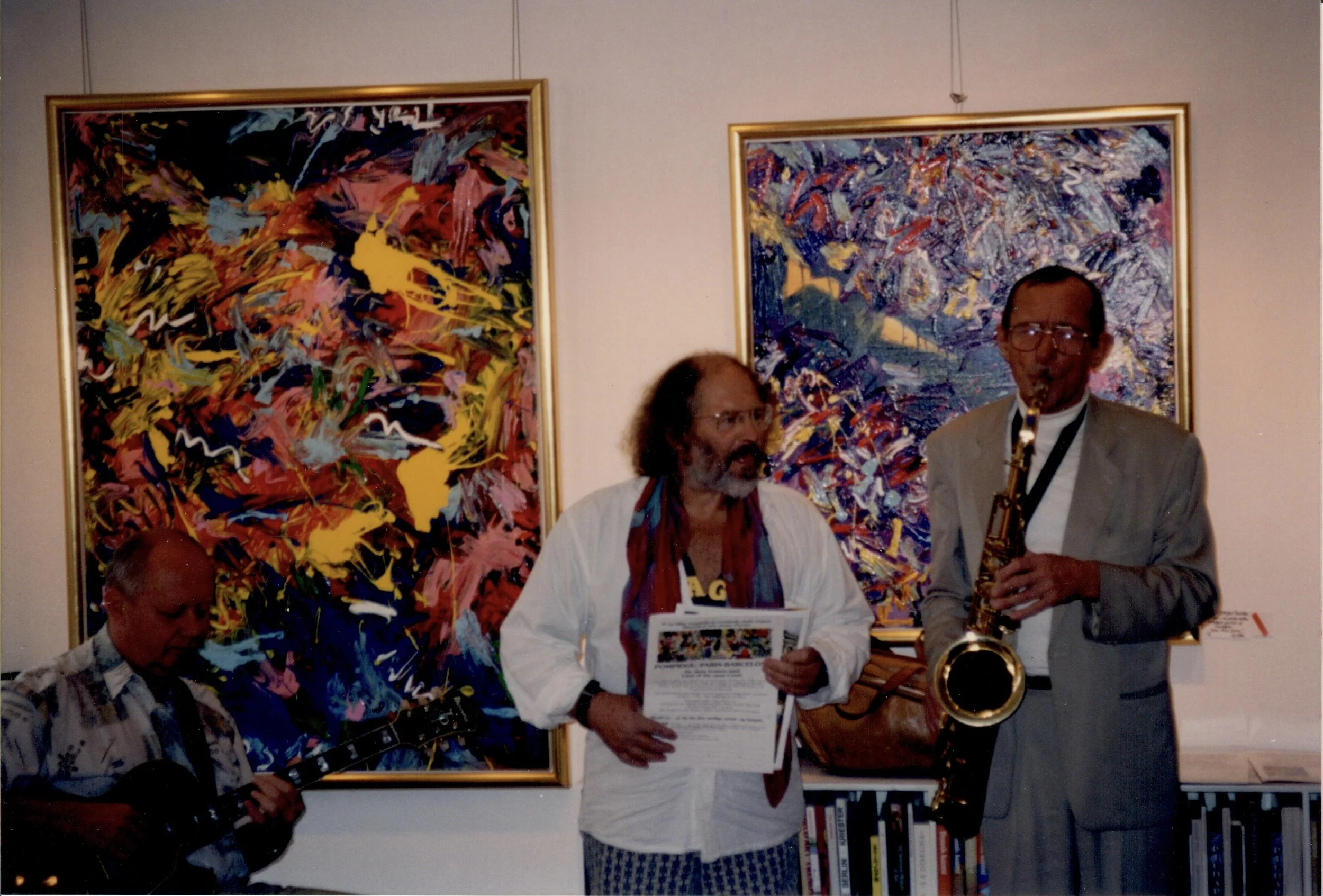
A portly man with frizzled, long hair and an unkempt beard, he read poetry aloud while a musician played an irreverent jazz tune on a saxophone. Initially, my natural introversion shrank back, embarrassed by his extroverted, over-the-top musings. Though spoken in a language I didn’t understand, the reaction of the crowd around him was boisterous and bawdy. Lighthearted laughter filled the air; entirely uncharacteristic of the public demeanor I had grown accustomed to. Yet, as I stood there, my guarded sense of order began to dissolve. I found myself drawn into the delightful chaos, experiencing a profound moment of borrowed confidence just by standing in the orbit of someone so utterly free.
Jens was avant-garde, but not at all pretentious or snobbish. In fact, he was quite warm and genuine. Around the room hung his expressive works for all to see: bold, vibrant colors brought to life by nudes frolicking across the canvas while the paint was still wet. Holding the accompanying booklet made the process clear, proving rather provocative as it guided ordinary people well out of their comfort zones toward a fresh look at the world.
Hanging alongside the main spectacle were smaller, more subdued pieces; one his own take on Monet’s famous water lilies. My Danish host mother, Kirsten, likely selected it because it reminded her of a trip to the Musée de l'Orangerie in Paris; a place I would later visit, though I always found myself liking Jens’ interpretation better than the original.
When Kirsten turned to me and asked, "Would you like to meet the artist?" I felt myself instinctively retreating into my introverted shell, only to be suddenly jolted out of it by a hearty slap on the back.
It was him!
Jens looked at me with a sincere smile, almost goofy like a child who had just played a naughty prank. His eyes sparkled, fierce and untamed. He spoke a sentence in rapid Danish, raised his glass of red—sipping the same Château Canon Bordeaux we were now sharing—clinked mine dramatically, slightly bowed, and moved away as quickly as he had appeared.
From a distance, I watched him approach an elderly lady, taking her waiting hand and causing her to blush like a teenager. He swept across the room, pulling every eye toward his fluid, unconstrained gestures.
In that moment, I wanted to be him. I envied his freedom from the paralyzing fear of judgment. I briefly put myself in his shoes, and it felt beautiful, elegant, and good. I took another sip of the Bordeaux, and any chill remaining of the afternoon lifted completely.
Not knowing Danish forced me to become wholly reliant on observing people and their behavior. Art and physical presence became the universal language, bypassing semantics entirely. Jens didn’t need syntax to command the room or connect with a hesitant stranger; his presence and the Bordeaux in our glasses anchored the experience.
I am sure whatever Jens said when we clinked glasses was witty, comical, or playful. We sipped once, and then it was over. The taste of the Bordeaux lingered, much like the paintings. And when it was time to leave, his water lilies and another lucky painting were wrapped in brown paper and tied with string, carried out under Kirsten's arm. The Danes have a word, hygge, and perhaps this cozy contentment was it; a feeling that would soon be celebrated with another bottle, perhaps a Nippozano Chianti, a family favorite served at their home on Anyvej street, followed by stories of Paris museums and Tuscan countrysides.
Jens died four years later, on November 15, 2000. I learned the news while attending a conference in Geneva, and that evening, I ordered a glass of Bordeaux. The physical memory rushed back: the taste of the wine, the saxophone’s notes, and the liberating electricity of that Copenhagen afternoon. Though the literal words he spoke remain a mystery, I understood him entirely. Some people require a dictionary to be known. Jens required only a brushstroke, a raised glass, and a life lived without apology. The translation, it turned out, was permanent.
- 🍇 -
Photo Credit: Nate Goetz